XMS6301


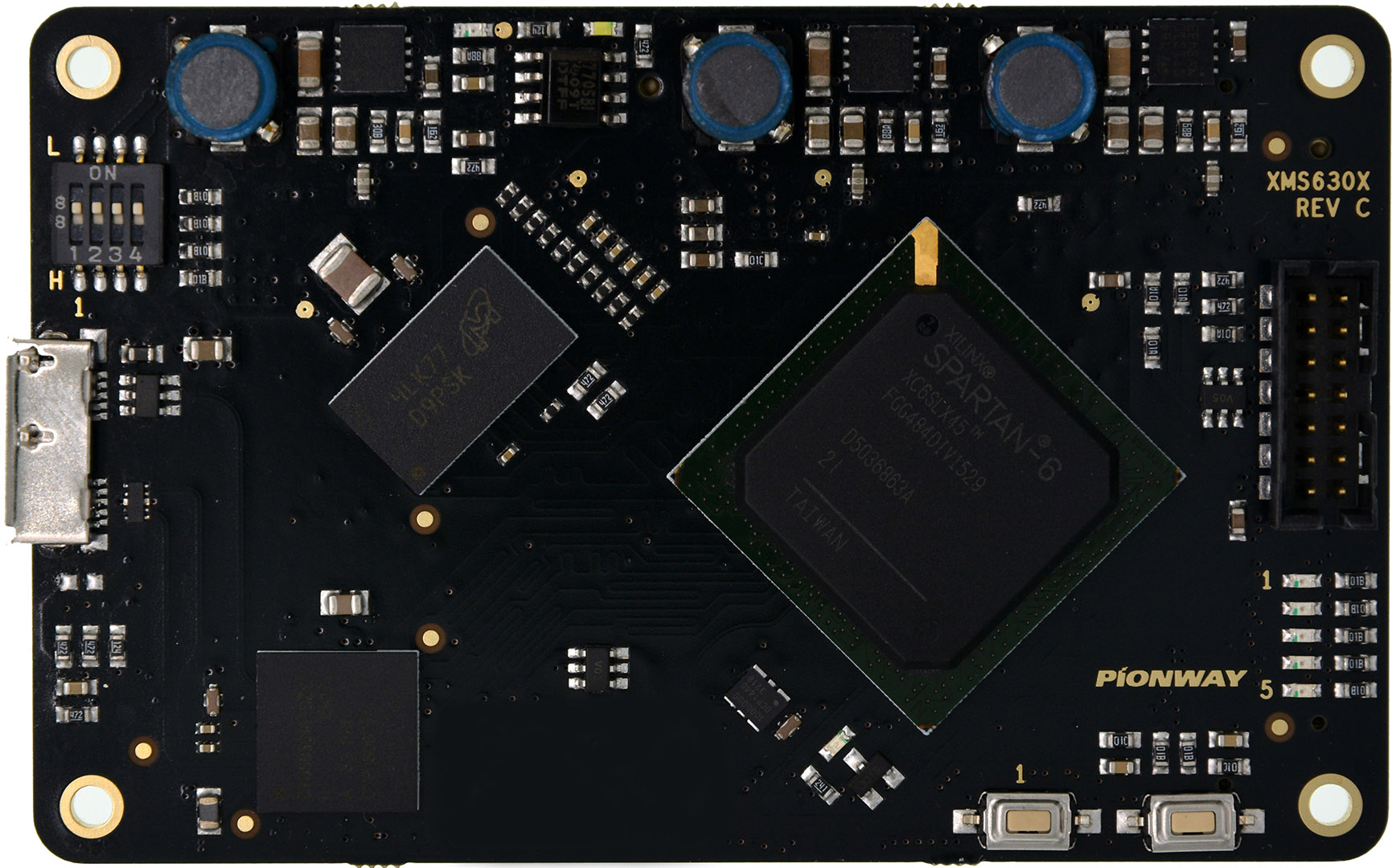
|
XMS6301-LX45 XC6SLX45-2I,256-MiB |
|
|
XMS6301-LX150 XC6SLX150-2I,256-MiB |
|
|
BRK6301 XMS6301 Breakout Board |
|
The XMS6301 is an FPGA integration module built around the Xilinx Spartan-6 FPGA, offered in LX45 and LX150 densities to fit projects of different scale. Its onboard USB 3.0 SuperSpeed interface handles FPGA configuration downloads and runtime host communication, supporting near-instant reprogramming and sustained data transfer rates of 340+ MiB/s to and from the PC via the Pionway SDK.
Pionway SDK
Pionway SDK is the host-side toolkit for the XMS6301: driver, API library, and matching FPGA-side IP that together manage USB enumeration, configuration downloads, and runtime data transfer. It gives your application a stable, well-documented interface to the module so your team can spend its time on the FPGA design and application logic instead of the low-level USB plumbing.
From Evaluation to OEM Production
Because the XMS6301 hardware, Pionway SDK, and reference designs are developed as one package, a design that starts on the bench as a quick proof-of-concept can carry forward into an OEM product with little rework of the host-side software. Two FPGA densities and volume pricing make it straightforward to scale from a handful of prototypes to a production run.
Block Diagram
256 MiB DDR3
256 MiB of onboard DDR3 gives your design local working memory for frame buffering, streaming capture, or other high-throughput workloads, without needing to round-trip through the host PC.
HIGH-EFFICIENCY POWER SUPPLIES
Onboard switching regulators supply clean, regulated power to the FPGA and module peripherals, with headroom left over to power a modest amount of external logic on your carrier board.
SUPERSPEED USB 3.0
In bench testing, the XMS6301 sustains PC-to-FPGA transfer rates above 340 MiB/s under typical operating conditions.
BOOTABLE SERIAL FLASH (2x 8 MiB)
Two 8 MiB serial flash devices are onboard: one dedicated to FPGA configuration for standalone boot, and a second available to your application for general nonvolatile storage.
Applications
- Image or video capture / processing
- Data acquisition
- ASIC / hardware-based simulation and verification
- Bioinformatics (DNA search and pattern matching)
- Digital communications
- High-speed USB / FPGA co-processor
- Evaluation platform for your product
- Custom test equipment
- Cryptography
- Data Security
Customer Deployments
- CMOS image sensor test equipment
- Radar system - test interface, system integration, field testing
- Evaluation platform for semiconductors
- Bioinformatics co-processors
- Camera interface for IR and LIDAR 3D cameras
- Equipment for analyzing satellite imagery
- Design of equipment for mineral exploration
- University research
- University classroom design projects
| FPGA | XMS6301-LX45 | XMS6301-LX150 |
|---|---|---|
| Interface Measured Performance |
USB 3.0 SuperSpeed 340+ MiB/s |
|
| FPGA Minimum Xilinx Tools Required |
XC6SLX45-2 ISE WebPack |
XC6SLX150-2 ISE Logic Edition |
| Slices | 4 6-LUT, 8 DFF | |
| Slice Count | 6,822 (54,576 DFFs) | 23,038 (184,304 DFFs) |
| FPGA RAM | 2,088 Kib BlockRAM 401 Kib Distributed |
4,824 Kib BlockRAM 1,355 Kib Distributed |
| MULT/DSP | 58 | 180 |
| MCB | ✓ | |
| PLLs | ✓(4CMT) | ✓(6CMT) |
| DDR3 Banks,Width,Peak Bandwidth |
256 MiB one, x16, 10 Gb/s |
|
| System Flash FPGA Bootable? |
8 MiB No |
|
| FPGA Flash FPGA Bootable? |
8 MiB Yes |
|
Technical Specifications and Support
Features & Specifications
- Xilinx Spartan-6 (XC6SLX45-2FGG or XC6SLX150-2FGG)
- 2x 8-MiB serial flash(Numonyx N25Q128A)
- 256-MiB DDR3 (Micron MT41K128M16JT-125)
- Small form-factor -- same a credit card at:85.5mm × 54mm
- SuperSpeed USB 3.0 interface (Cypress FX3) for configuration and data transfer
- Measured performance over 340 MiB/s
- Self-powered by external Board to Board or USB Connector
- Low-jitter 100 MHz MEMS clock oscillator
- five LEDs
- 114 user I/O and 16 GCLK pins on expansion connectors
- Independent access to VCCO bank voltages
- JTAG pins available on the expansion connectors
- Full Pionway SDK support
- Application Programmer's Interface (API) in C, C++