Pionway SDK


Pionway SDK is the toolkit that connects your FPGA design to your PC application over USB or PCI Express. It brings together three pieces you would otherwise have to build yourself:
-
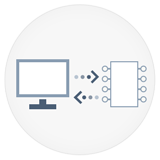
A host-side software API and driver for talking to your device over USB.
-

Onboard device firmware that manages FPGA configuration and runtime communication.
-

Compact FPGA IP modules you drop into your HDL to handle host communication.
Multi-Platform Pionway API and USB Driver
The Pionway API and USB driver present the same programming interface to your application regardless of whether you're running on 32-bit or 64-bit Windows, so code you write against one target keeps working as your development environment changes.
Ready-made bindings are included for C, C++, and Python, and because the core is a standard DLL, it can also be called from any environment that supports external library calls — including MATLAB and LabVIEW — without extra wrapper code on your part.
-
HDL Interface Modules
The HDL modules included with the SDK implement the FPGA side of the USB link, so you don't have to design a custom communication protocol from scratch. Instantiate them in your design and you get a compact, ready-tested path for moving data and control signals between your hardware and your host software.
-
Simulation Models
Behavioral simulation models are provided for the PC-to-FPGA interface so you can verify your design's logic before it ever touches real hardware, catching integration issues earlier instead of debugging them on the bench. The models are compatible with Xilinx ISim, ModelSim, and other common HDL simulators.
-
Custom Interfaces and Test Hardware
Teams building in-house prototypes, lab instruments, and other one-off hardware use the Pionway SDK's virtual interface components and programmer's interface to get a working PC-to-FPGA link running quickly, without having to design and validate a custom protocol for every new project.
Technical Specifications and Support
Features & Specifications
- Windows (USB / PCI) API available as DLL C/C++/Python libraries
- Behavioral simulation supported, no back-annotation
- USB 3.0 transfer rates up to 340+ MiB/s
Requirements
- Windows 7, Windows 8.1, Windows , Windows 11
- Simulation: Compatible with most VHDL/Verilog simulators
- Pionway SDK-supported device
- Xilinx ISE 14.1i or later recommended for building FPGA configuration files (Spartan-6 and earlier)